Fear Is Not Respect: Why Obedience Isn’t Good Behavior


There is something we rarely question about the way we raise children, relate to one another and exercise authority in our homes, schools, workplaces and relationships. We have become so accustomed to certain behaviours that we no longer recognise when they are harmful. We call them discipline, respect, good upbringing and sometimes even culture. Yet, beneath these familiar expressions are practices that can silence people, discourage independent thinking and make it difficult for individuals to recognise or challenge mistreatment.
A child who does not question an adult is described as well-brought-up. An employee who never challenges a supervisor is considered loyal. A woman who does not disagree with her husband is praised for being respectful. Somewhere in these actions, we began to confuse respect with submission and obedience with good behaviour. Perhaps one reason this confusion has lasted so long is that it benefits those who hold power.
No one is disputing the fact that respect is important and of course, children need guidance, workplaces need structures, families need boundaries, and societies need rules. But there is a difference between recognising legitimate authority and believing that someone should never question the person exercising it. Authority should come with responsibility. It should not become permission to intimidate, humiliate, control or silence others.
The problem begins when we teach people that having a voice is a sign of disrespect.
When obedience becomes the measure of good upbringing
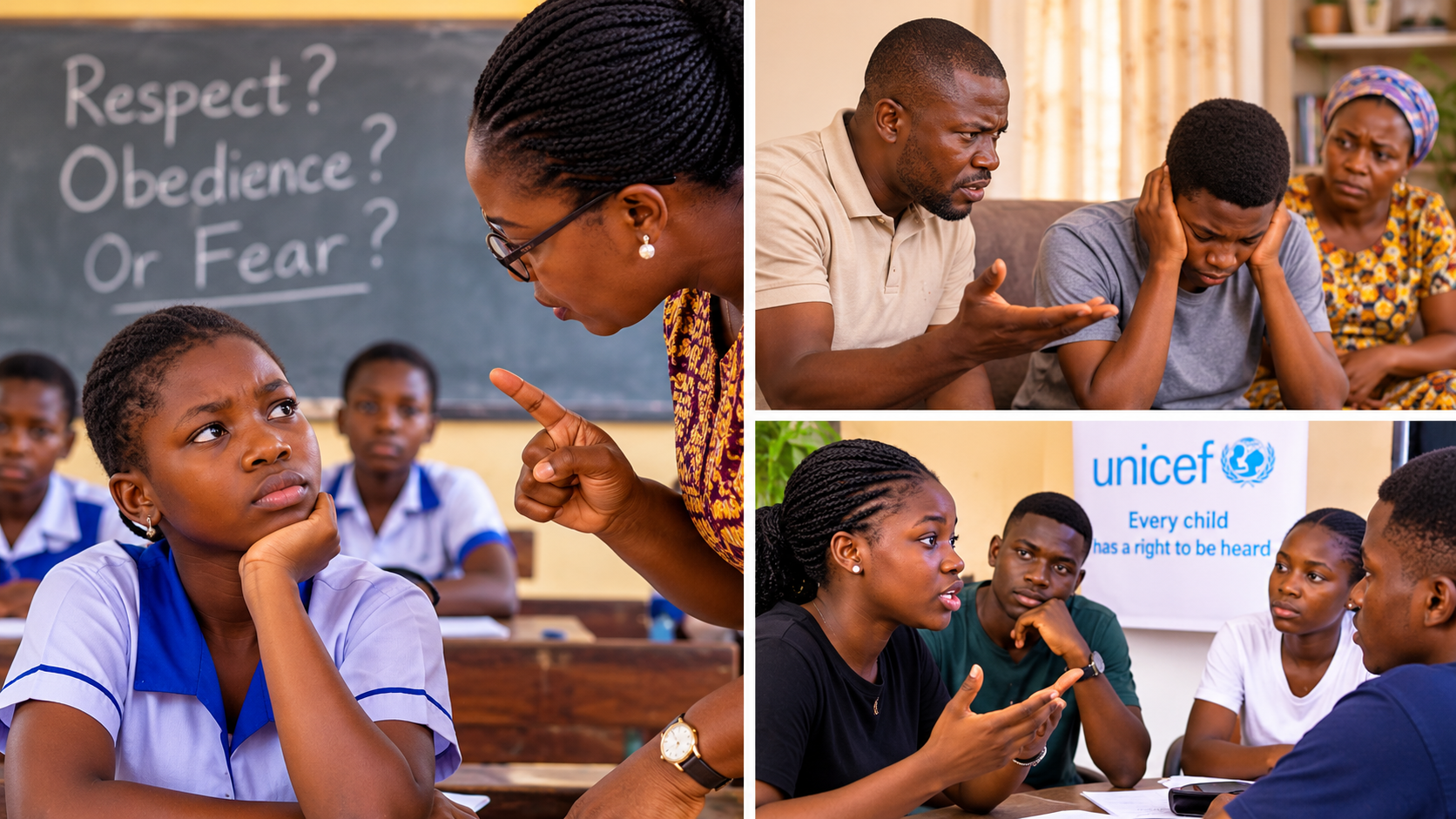
Think about the messages children receive while growing up. They are frequently told not to talk back, not to question adults, not to interrupt, and not to challenge decisions made by their parents or other authority figures. In some households, a child asking why they are being punished is enough to attract another punishment. Expressing a different opinion can be interpreted as stubbornness, arrogance or a lack of home training.
The United Nations Convention on the Rights of the Child makes this distinction particularly important. Article 12 recognises that children who are capable of forming their own views have the right to express those views freely in matters affecting them. Their opinions should be given due weight according to their age and maturity. Article 5 also recognises parental guidance, but places that guidance within the context of children's evolving capacities and rights (United Nations, 1989).
This means that recognising a child's rights does not require parents to surrender their responsibilities. It requires adults to understand that children are individuals with thoughts, feelings and experiences that deserve consideration.
Yet, how many children, in fact, how many of us grew up believing that disagreeing with an adult is okay? How many learn to remain silent even when something makes them uncomfortable because they have been taught that questioning an older person is unacceptable?
We should be concerned about this because children do not learn only from what adults tell them. They also learn from how adults treat them.
UNICEF's work on positive parenting and violence prevention emphasises the importance of non-violent discipline, effective communication and positive parent-child relationships. Its guidance recognises that parenting practices can either reinforce harmful social norms or help challenge them (UNICEF, 2020).
The distinction matters. A child who understands why a rule exists is learning something different from a child who follows it simply because they are afraid of being beaten, insulted, or humiliated.
We have made fear look like discipline

Perhaps one of the most concerning examples of this confusion is how easily violence is defended as a necessary part of raising children. In many communities, physical punishment is still discussed as though it were evidence of responsible parenting. Adults sometimes explain that they were beaten as children and turned out well. Others argue that children who are not punished physically will become disrespectful, irresponsible or difficult to control.
But the fact that a practice is familiar does not establish that it is beneficial.
UNICEF estimates that approximately 1.6 billion children globally, or two in every three, regularly experience violent punishment by caregivers at home. This includes physical punishment and psychological aggression, such as shouting at children and calling them offensive names. UNICEF also reports that violent discipline can have immediate and long-term negative consequences for children's development (UNICEF, n.d.).
This is not a small disagreement about parenting preferences. It is a significant child protection concern.
We rarely ask what the child has learnt from that experience. Did they understand why their behaviour was wrong? Did they develop better judgement? Or did they simply learn that the person with more power can hurt them and expect them to accept it?
There is a difference between teaching children accountability and teaching them to fear authority. We should stop treating the two as interchangeable.
The same behaviour follows us into adulthood
It would be convenient to treat this as a parenting problem, but the pattern does not necessarily end when childhood does. Look at the workplace. Employees are sometimes expected to accept unreasonable demands because a supervisor is senior. Someone who raises concerns may be described as difficult, uncooperative or lacking respect. In some organisations, people learn to agree in meetings even when they recognise that a decision is harmful or poorly thought out.
The problem is not that workplaces have hierarchies. Organisations need leadership, accountability and clear responsibilities. The problem arises when seniority becomes a reason to disregard the experiences and rights of people in less powerful positions.
A healthy workplace should allow employees to raise concerns without fearing humiliation, retaliation or professional punishment. Respect should move in both directions. A job title may give someone decision-making responsibility, but it does not make that person incapable of being wrong.
The same contradiction appears in relationships. We sometimes praise people for tolerating behaviour that should concern us. A partner who monitors someone's movements, controls their friendships or makes decisions on their behalf may be described as protective or caring. Jealousy is interpreted as love, while disagreement is treated as a challenge to authority.
This is particularly important when discussing gender-based violence. Violence is not sustained by physical aggression alone. Controlling behaviour, intimidation, economic abuse and the belief that one person is entitled to dominate another can also form part of abusive relationships.
When someone believes that their authority entitles them to unquestioned obedience, the other person's autonomy becomes negotiable.
We need to rethink what good behaviour actually means
Perhaps the question we should be asking is not whether people know how to obey, but whether they understand how to treat others (what is the why?)
A well-behaved child should not simply be one who never questions an adult. They should be someone who is learning empathy, responsibility, honesty and respect for other people's boundaries. A good employee should not be measured only by how readily they agree with management, but also by their integrity, professionalism and willingness to raise legitimate concerns.
A respectful partner should not be someone who always gets their way, but someone who recognises that the other person has an equal right to make decisions, express opinions and maintain their independence.
And a responsible person in authority should understand that leadership is not demonstrated by how many people are afraid to challenge them. It is demonstrated by how they treat people who have less power than they do.
We do not have to abandon discipline, cultural values, parental guidance or leadership to make this distinction. We simply need to stop using these ideas to justify behaviour that denies people their dignity.
Perhaps we should stop asking whether our children, employees, partners and younger people are obedient enough. We should start asking whether the environments we create allow them to think, speak, disagree and feel safe.
Because if the only way we can maintain authority is by making other people afraid of us, then the problem is not their lack of respect, maybe it is our understanding of power.
 Dorcas Kongwie

 Dorcas Kongwie